
Online gaming, international friendships and digital relationships are reshaping how young people experience community, intimacy and cultural differences. While parents may see isolation, their children might be participating in an entirely new form of global socialisation. But what do they gain, and what might they lose along the way?
This article is the second instalment in a series exploring how digital technologies are transforming human relationships. While the first article examined online dating and the changing nature of romantic relationships, this instalment turns to a younger generation whose friendships, first loves and social lives increasingly extend beyond geographical borders.
Author: Olga Nádra
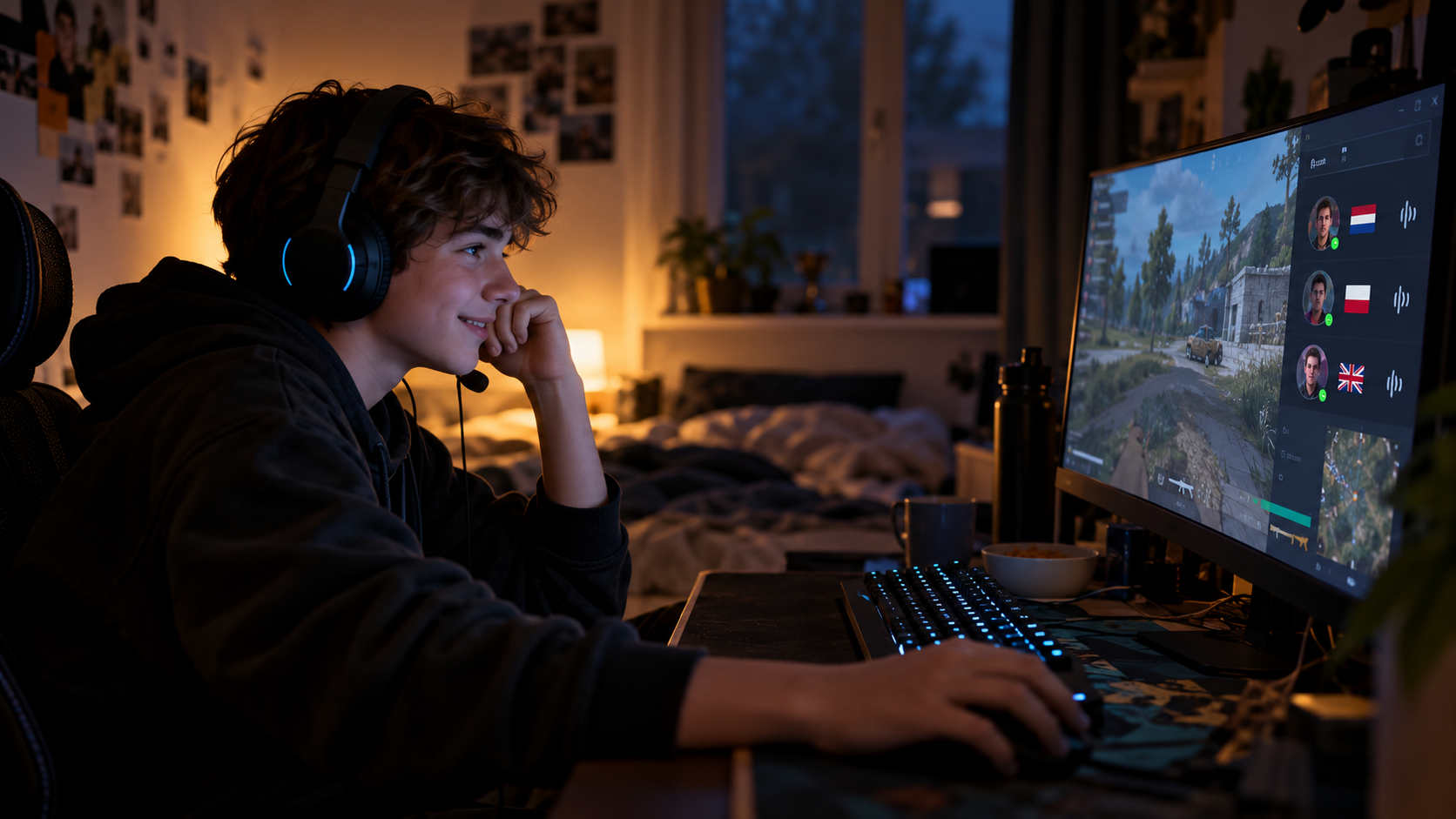
A child sits in their bedroom, wearing headphones, having spent hours in front of a computer. From the outside, they appear to be alone. Yet they are talking to someone from the Netherlands, playing alongside a Polish teenager, debating with a British player and perhaps telling a friend about their day, even though they have never met in person. Has this child become isolated from society, or are they participating in an international community that previous generations could never have accessed at such a young age?
In debates about online gaming, we often treat childhood before the internet as our natural point of reference. A friend was someone we met in person. Our first love was a classmate, the boy or girl next door, or perhaps someone we met at summer camp. In the afternoons, we went outside to play football, knocked on each other’s doors and spent time together after school. Physical presence was an essential part of social life, and apart from the usual parental concerns, adults generally considered this entirely natural. For today’s children, however, the possibilities for developing social relationships extend far beyond this familiar world. Digital technology has not simply provided them with new communication tools. It has created entirely new social environments in which geographical distance, nationality and certain social differences can become less significant than previous generations might ever have imagined.
Those Who May Never Meet
If two teenagers talk every evening for months, know each other’s fears, sense of humour and secrets, look forward to hearing from one another and miss each other when they are absent, is their relationship somehow less real simply because hundreds or even thousands of kilometres separate them? And what happens if they fall in love? For generations that grew up primarily in an offline world, the idea of a first romance unfolding through online games, messages or video calls may seem unusual. It is easy to assume that such relationships are somehow less authentic. Yet the emotions involved can be entirely genuine.
Anticipation, happiness, jealousy, trust, disappointment and even the pain of a first heartbreak do not become virtual simply because they are experienced through a screen. Emotional attachment does not necessarily require two people to occupy the same physical space, even if personal presence can add dimensions to a relationship that digital communication cannot fully reproduce. Rather than asking only what a generation might lose as a significant part of its social life moves online, we should also consider the new opportunities for human connection that this transformation creates.
Friendships Without Borders
If we accept that the emotions experienced in an online romantic relationship can be entirely genuine, why should we think differently about friendships? A teenager may spend evenings with the same group of people for months or even years without ever meeting them in person. They play together, talk, laugh, argue and reconcile. They know who had a difficult day at school, who argued with their parents, who is worried about an upcoming exam and who simply is not feeling well. They miss one another when someone disappears for a few days. What necessarily makes such friendships any less real?
Online environments can also bring together children who would probably never encounter one another in the physical world. The child of a diplomat, attending excellent schools and growing up in financial security, might become friends with a child living in an economically disadvantaged region of another country. In everyday life, they would probably never attend the same school, join the same sports club or belong to the same social circle. Yet online, their social backgrounds are not necessarily the first things they discover about each other.
One is no longer primarily the diplomat’s child, while the other is not simply the poor kid. One happens to be an excellent strategist, another is exceptionally fast, and a third always makes everyone laugh. Someone else becomes the person you can talk to at midnight when something is bothering you. Shared interests and regular interaction can create friendships that transcend not only national borders but also time zones.
Of course, the internet does not eliminate social inequality. Access to a personal computer or gaming console, a reliable internet connection, a suitable smartphone and sufficient leisure time already reflects significant differences in economic circumstances. Financial backgrounds may eventually become visible in online communities, which are certainly not immune to prejudice or social inequality. Nevertheless, something remarkable can happen. Two children may get to know each other as individuals before discovering what kind of houses they live in, which schools they attend, what clothes they wear or what their parents do for a living. Social status is not necessarily the first piece of information on which they base their opinions of one another.
Perhaps, then, the value of an online friendship should not be measured by whether two people have ever sat together on a park bench. Instead, we might consider whether they trust each other, can rely on one another, share what matters to them and genuinely miss each other when they are apart. Their shared space may be virtual, but their relationship can nevertheless be entirely real.
A Language Lesson Without Realising It
International online communities have another, less obvious consequence. Children often begin communicating in foreign languages without even realising that they are learning. They do not search for English words because they have a vocabulary test the following morning. They do so because they need to explain something to a teammate at that very moment. They must understand the response, react quickly and express themselves in situations that have genuine significance to them. Gradually, they may acquire humour, abbreviations, slang and familiarity with different accents. They also learn how to understand people for whom English, just as for themselves, is not their native language.
In this environment, language is not an academic subject but a practical tool. It enables them to establish relationships, resolve conflicts and achieve common objectives. Naturally, this experience cannot entirely replace structured language education, but it can provide practical experience and communicative confidence that may be more difficult to develop in a traditional classroom. Beyond language acquisition, however, we may be witnessing an even more interesting transformation. Children growing up in digital communities can experience international cooperation and intercultural communication from a remarkably young age. They may encounter different social customs, ways of thinking and personal circumstances at a stage of life when previous generations were still largely influenced by their families, schools, neighbourhoods and a handful of local communities.
For a teenager today, it may seem entirely natural that one friend is German, another Polish and a third Dutch. None of them necessarily considers it particularly remarkable that they were born in different countries. They simply meet in the same place every evening, except that this particular place does not exist in the physical world. In this sense, international online communities offer a distinctive form of cultural exposure. Another country is no longer necessarily just a geographical area on a map or a society described in a school textbook. It is the home of the person they were playing with the previous evening.
Of course, interacting regularly with people from different countries does not automatically guarantee cultural openness or eliminate prejudice. It does, however, create opportunities for children to encounter national and social differences through personal relationships rather than exclusively through abstract concepts. In a world where international cooperation increasingly shapes everyday life, these experiences may prove valuable well beyond childhood.
What Digital Communities Cannot Replace
None of this means that online social interaction can seamlessly replace personal relationships. Recognising the opportunities created by digital environments is important, but so is understanding which experiences and skills might receive less attention if virtual relationships gradually begin to displace physical communities. Face-to-face encounters help us develop social skills that are practised differently, or sometimes less frequently, through screens. We learn to interpret body language, recognise facial expressions and respond to other people’s emotional reactions. We must tolerate uncomfortable silences, navigate disagreements and deal with situations from which we cannot simply escape with a single click. If we argue with a classmate, for example, we will probably still have to face them the following morning.
One of the defining characteristics of physical communities is that they bring us into contact with people we might never have chosen to meet. We must learn to cooperate with individuals who do not necessarily share our interests, values or worldview. In digital environments, by contrast, we often have considerably greater freedom to decide whom we wish to interact with. That freedom presents both opportunities and limitations. While it becomes easier to find people with similar interests, we may have fewer opportunities to practise adapting to those who are fundamentally different from us.
Physical presence also has qualities that digital communication cannot currently reproduce. A hug, a football match with friends, a concert or that awkward moment when two teenagers hold hands for the first time are experiences whose significance comes partly from direct human contact. There are also risks specific to online environments. Children cannot always be certain who is actually sitting behind another screen. Anonymity can facilitate deception, harassment and exploitation, while emotionally intense relationships conducted exclusively online may make warning signs particularly difficult to recognise.
The freedom offered by international digital communities also means that parents often know considerably less about the people who have become part of their children’s everyday lives. Traditionally, parents could usually establish at least which school a friend attended, where they lived or who their parents were. When a child’s closest friend lives in another country and the relationship exists entirely online, such information may not be readily available. The question, therefore, is not simply how much time children spend online, but whether they are sufficiently equipped, according to their age and maturity, to recognise and manage the risks associated with digital relationships. Parental involvement, mutual trust and digital literacy may be just as important in this context as setting limits on screen time.
Perhaps We Are Asking the Wrong Question
When we see a child sitting alone in their bedroom, we may instinctively conclude that they have become socially isolated. Based on the experiences of previous generations, social life has traditionally been associated with physical presence. Its apparent absence can therefore easily create the impression of loneliness or declining social connections. But are we certain that the child is actually alone?
Perhaps they are talking to people living in five different countries, joking in English or listening to the problems of a friend whose living circumstances they would know almost nothing about without the internet. Perhaps their best friend is there, someone they have spoken to regularly for years despite never having met in person. And yes, perhaps their first love is there too. Equally, however, that same child might be leaving their bedroom less frequently, spending less time with family and local friends, becoming increasingly physically inactive and gradually allowing digital communities to displace other activities that are equally important for their development.
From the outside, these two situations may look almost identical. That is precisely why judging the quality of children’s social lives exclusively by the amount of time they spend in front of screens can be misleading. When discussing online gaming, therefore, perhaps the most important question is not whether games are inherently good or bad, or even simply how many hours children spend online. We should also seek to understand what they do there, whom they interact with, what experiences they gain and which other aspects of their lives might be receiving less attention as a result.
What generations raised in an offline world sometimes interpret as social alienation may, at least in part, represent something entirely different: the emergence of a new form of socialisation. A social world in which the value of friendship is no longer necessarily determined by geographical proximity, communities do not stop at national borders and a first romance does not always begin in a classroom. This transformation does not make personal relationships obsolete. Rather, it challenges us to reconsider what belonging to a community means for a generation whose social environment exists simultaneously in the physical and digital worlds.
Perhaps the real question is not simply whether the internet is disconnecting our children from society, but what kind of society they are growing into through it.
Cover photo credit: CEA Magazine. AI-generated illustration created with OpenAI for CEA Magazine.

Olga Nádra is a social worker and a specialist in gerontology and mental health. She completed her studies at Kodolányi János University. She has more than fifteen years of practical experience in elderly care as well as in supporting people with psychiatric conditions. Her work is grounded in empirical insights gained in the field, through which she engages with questions related to mental health, care systems and the social welfare system. She believes strongly in lifelong learning and therefore continues to deepen her professional knowledge through ongoing training and research.
Support independent analysis and journalism at CEA Magazine: https://centraleuropeanaffairs.com/donation
For more insights on Central European political risk, EU institutional developments, and transatlantic relations, follow CEA Magazine and the CEA Talk podcast.
